
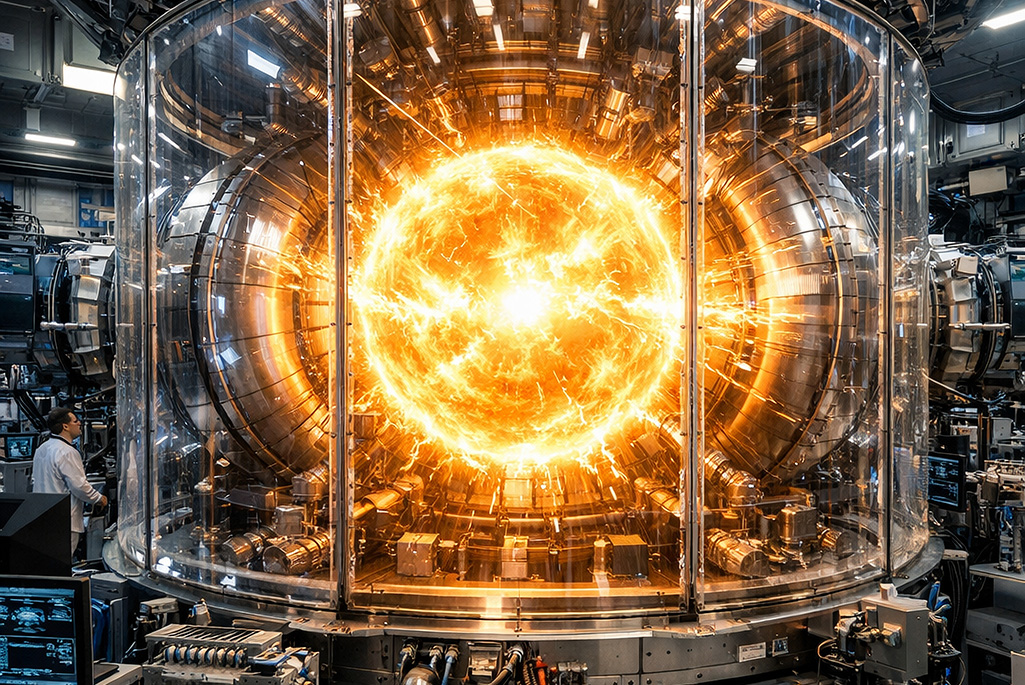
Our sun shines through fusion, in which hydrogen atoms are forced together at immense temperatures and pressures to form helium, releasing enormous amounts of energy. If fusion can be achieved on Earth, it could unlock a nearly limitless source of clean energy. However, achieving it poses significant scientific and engineering challenges.
At the Department of Energy (DOE)’s Lawrence Berkeley National Laboratory (Berkeley Lab), researchers in the Accelerator Technology & Applied Physics (ATAP) Division are tackling that challenge from multiple angles. In collaboration with partners across Berkeley Lab, universities, and private companies, they are developing the tools, materials, magnets, and models needed to make fusion a viable power source.
Here are some of the many ways ATAP researchers are advancing fusion research.
Caging a star
One of the biggest obstacles to fusion is reaching the necessary temperature. Deuterium-tritium fusion, the most commonly used approach, requires heating hydrogen to about 150 million °C—more than 10 times hotter than the Sun’s core—to overcome electrostatic repulsion and allow the nuclei to fuse. However, no known material can withstand such temperatures without being instantly vaporized.
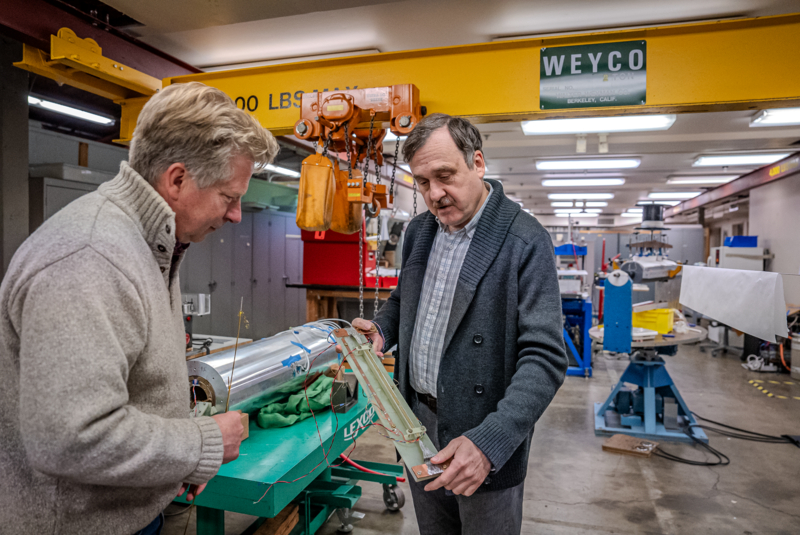
A solution is to confine this superheated gas, called plasma, within powerful magnetic fields in doughnut-shaped devices such as the tokamak and the stellarator. This approach, called magnetic confinement fusion, is among the leading methods for achieving fusion. Researchers from ATAP’s Superconducting Magnet Program and Berkeley Lab’s Engineering Division, along with collaborators, are working with industry partners to develop magnets capable of generating magnetic fields strong enough to confine plasma. These high-temperature superconducting magnets use superconducting coils made from rare-earth barium copper oxide tape, capable of generating magnetic fields of 20 tesla or more.
Berkeley Lab’s decades of magnet expertise are helping both government programs and a wave of fusion start-ups harness this technology to build the compact, powerful magnets that future magnetic-confinement fusion reactors will need.
Testing fusion materials
Even outside the plasma, a fusion reactor remains a harsh environment. Fusion produces high-energy neutrons—subatomic particles that carry away much of the reaction’s energy and relentlessly slam into the reactor’s walls and components. Building materials that can withstand this bombardment for years are essential to achieving controlled fusion.
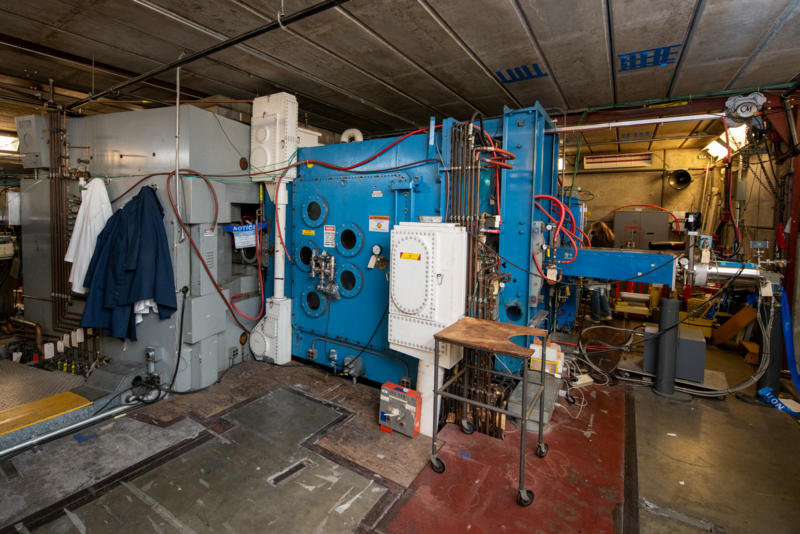
To study how materials used in fusion reactors withstand these demanding conditions, ATAP and Berkeley Lab’s Nuclear Science Division offer a suite of advanced particle sources. At the Nuclear Science Division’s 88-Inch Cyclotron, researchers produce intense beams of fast neutrons to test how materials degrade under radiation and to calibrate sensitive detectors. Within ATAP, a compact neutron generator enables detailed 3D material mapping and helps interpret complex signals from fusion experiments.
To observe damage as it unfolds, ATAP’s High-Repetition-Rate Electron Scattering facility can capture what happens inside materials on timescales as short as a trillionth of a second. This provides fusion researchers with an unprecedented, real-time view of how tiny defects form and evolve—knowledge that directly informs the design of more resilient, longer-lasting reactor components.
Looking ahead, ATAP is also developing better ways to heat and fuel fusion plasmas using techniques such as Neutral Beam Injection, which injects particle beams into the plasma to keep it hot and burning.
Visualizing experiments for fusion
Not all fusion relies on magnets. Another leading approach, inertial confinement fusion, uses intense bursts of laser energy to compress a tiny pellet of deuterium and tritium (isotopes of hydrogen) so quickly and forcefully that the pellet fuses. Studying these lightning-fast events requires equally fast tools.
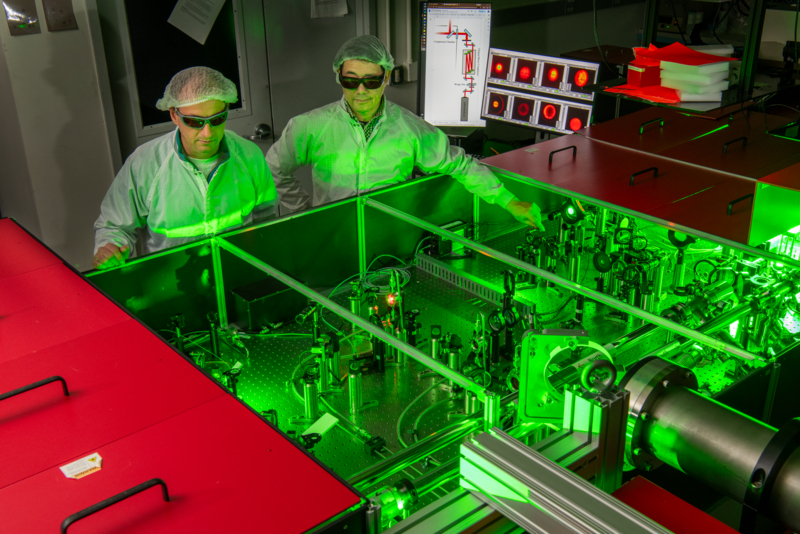
At ATAP’s BELLA Center, researchers use some of the world’s most powerful lasers to generate intense, ultra-short pulses of light and charged particles that last only trillionths of a second. These flashes act like an extraordinarily fast camera, allowing researchers to observe the complex, split-second processes within fusion plasmas.
“BELLA’s ultra-intense lasers interact with plasmas to produce extremely short, less than one picosecond long, extremely bright bursts of electrons, protons, X-rays, gamma rays, and muons,” explains Jens Osterhoff, a senior scientist and the director of the BELLA Center. “Because they are so short and can be precisely synchronized, they allow us to capture ‘movies’ of fast processes, such as shockwave propagation, with high temporal and spatial resolution.”
A recent example is a LaserNetUS experiment, part of a North American network that provides access to high-power laser facilities for high-energy-density science and fusion research. The experiment, led by the University of Michigan, was conducted on BELLA’s Hundred-Terawatt laser and used X-rays and electrons to study how a shockwave affects water. A variation of the technique could be used to investigate the extreme conditions of an inertial confinement fusion target.
BELLA is also exploring how laser-driven ion acceleration from novel targets, such as foams, could push proton energies from tens of MeV to beyond 100 MeV and increase their intensity. Such beams are “directly relevant to fast-ignition concepts and to radiographing the fields and density structures inside fusion plasmas,” says Osterhoff.
Modeling fusion
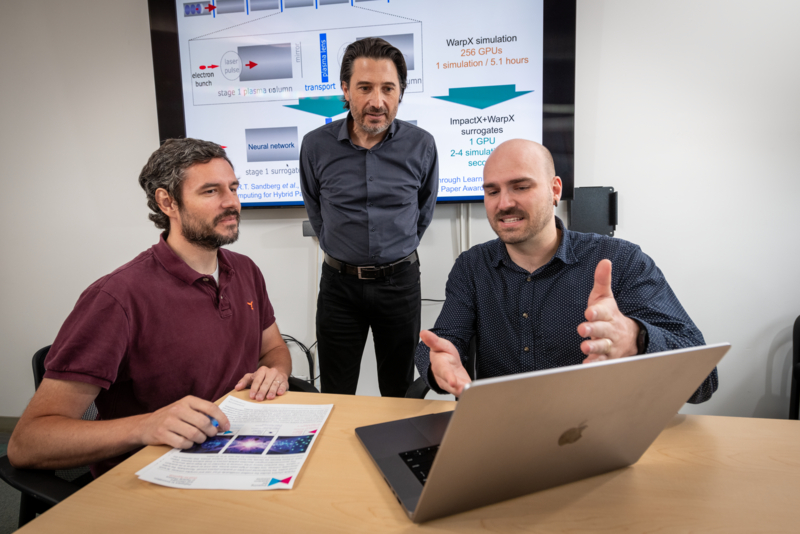
Because conducting real fusion experiments is both expensive and difficult, scientists rely heavily on computer simulations to test ideas before building anything. Berkeley Lab’s Advanced Modeling Program (AMP) is a world leader in this field, using exascale supercomputers—machines capable of performing a billion billion calculations per second—at the National Energy Research Scientific Computing Center (NERSC) at Berkeley Lab.
These simulations model everything from the behavior of individual particles to the operation of an entire fusion facility. AMP is leading a multi-laboratory collaboration through the DOE’s Scientific Discovery through Advanced Computing (SciDAC) program, the Kinetic IFE (Inertial Fusion Energy) Simulations at Multiscale with Exascale Technology (KISMET). KISMET combines the power of exascale computing with the latest advances in first-principles kinetic modeling of laser-plasma interactions to accelerate progress toward a laser-driven inertial fusion pilot power plant. The collaboration brings together plasma physicists from Berkeley Lab, Lawrence Livermore National Laboratory, and the University of Rochester, computer scientists from the SciDAC Math Institute at Berkeley Lab, and an industry partner to extend the capabilities of the award-winning WarpX code to explore the physics and mitigation of laser-plasma instabilities, the concept of proton-based fast ignition, and the physics of hot spots.
Berkeley Lab has also pioneered a “superfacility” model that links live experiments to its supercomputers. In one demonstration, data from General Atomics’ DIII-D tokamak was streamed over a high-speed network to NERSC’s Perlmutter supercomputer for near-instant analysis—providing researchers with rapid feedback on their experiments. AMP has leveraged Berkeley Lab’s superfacility tools to build a Digital Twin prototype that runs and updates a BELLA experiment model on the Department of Energy’s AI Genesis Mission American Science Cloud.
“Combined with experiments, exascale computing provides the raw data that artificial intelligence uses to build the intelligent models and systems that will bring fusion to the grid,” explains Jean-Luc Vay, a senior scientist and head of AMP. “AMP focuses on developing combined numerical methods and AI solutions to transform how we design, test, and ultimately operate the fusion reactors of tomorrow.”
The role of artificial intelligence
Increasingly, the computing power of facilities such as NERSC is being paired with artificial intelligence (AI). Through the Department of Energy’s AI Genesis Mission—a major effort to accelerate American scientific discovery with AI—Berkeley Lab is developing AI models tailored for fusion. These models learn from both simulations and real experimental data, helping researchers detect plasma instabilities, speed calculations, and build “digital twins”—virtual copies of fusion reactors that predict how a real machine will behave. The ultimate goal is for fusion experiments to run in part autonomously, adjusting in real time as conditions change.
Fundamental nuclear physics
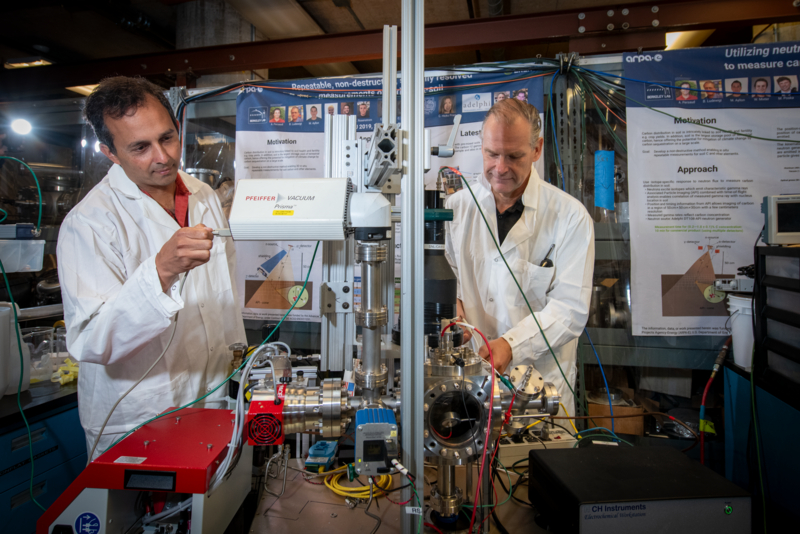
In addition to its potential as an energy source, fusion can offer insights into fundamental nuclear physics. In a July 18, 2026, study published in Nature Communications, ATAP scientists and colleagues at the University of California, Davis, packed deuterium—a heavy form of hydrogen comprising a proton, a neutron, and an electron, commonly used in fusion experiments—into thin metal foils of palladium and titanium. They then fired deuterium-ion beams at the foils and measured the fusion rate. At low energies, below 2.5 keV, where fusion rates should fall sharply, they instead found that fusion occurred at rates roughly a quintillion (one billion billion) times higher than expected.
“The enhancement we measured is remarkable, but the conditions are nowhere near those required for fusion energy, and the absolute rates remain low,” says Arun Persaud, a senior scientist and head of ATAP’s Fusion Science & Ion Beam Technology Program. “Still, this offers a reproducible way to study how materials affect nuclear reactions, and that’s a direction worth pursuing.”
While the exact mechanisms behind this are unknown, the researchers believe that electrons and tiny imperfections in the metal may help shield the natural repulsion between atomic nuclei, allowing them to come close enough to fuse. Understanding this effect could one day enable scientists to design materials that actively promote fusion under certain low-temperature conditions, much as a chemical catalyst accelerates a reaction.
From the lab to the real world
None of this would matter if the technology remained locked in the lab. That’s why Berkeley Lab partners closely with private companies and other organizations to advance fusion from concept to reality. Through programs such as the Innovation Network for Fusion Energy, funded by the Department of Energy’s Office of Fusion Energy Sciences, LaserNetUS, and BeamNetUS, a network of facilities dedicated to advancing particle accelerator research and technology by providing access to beam test facilities within the U.S. national laboratories, Berkeley Lab provides companies with access to its specialized facilities, world-class staff, and extensive computing resources. Just as importantly, it offers regulatory and safety expertise to help partners navigate the challenging path from prototype to commercial product.
To learn more…
When It Comes to Fusion, Materials Matter
The Technologies Fueling the Future of Fusion
A New Way to View Shockwaves Could Boost Fusion Research
Fusion Research Enters New Era
For more information on ATAP News articles, contact caw@lbl.gov.